
Stuart Forster discussed visiting Studio Bell, the home of Canada’s National Music Centre, in Calgary, Alberta.
Disclosure: In June 2017, I had an opportunity to spend a week in Calgary. I travelled there as part of Destination Canada’s City Bloggers Plus project, involving 15 leading UK travel bloggers. The bloggers were distributed in cities across Canada. Some of the links below and banners are affiliate links, meaning, at no additional cost to you, I will earn a commission if you click through and make a purchase.
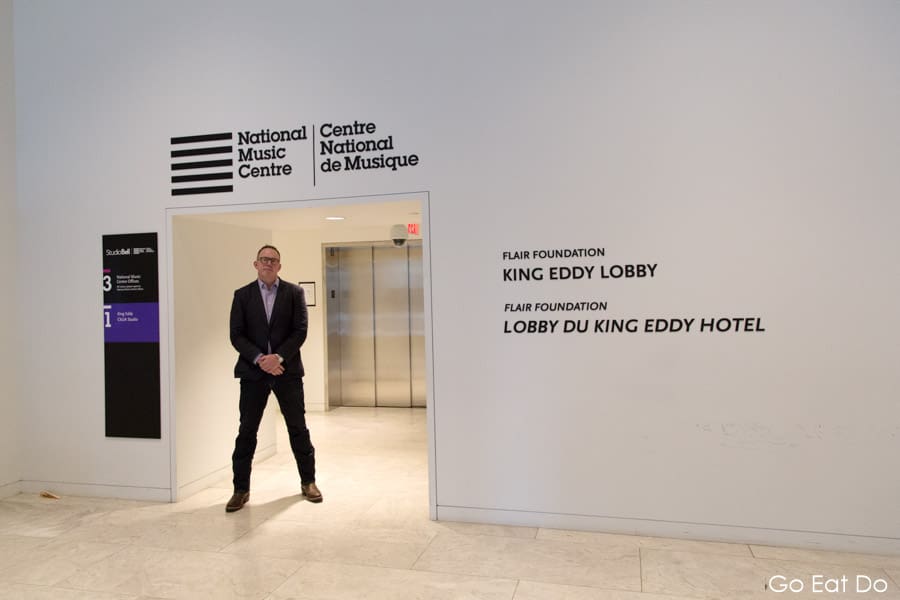
“It’s good to see you’re expressing yourself through writing and photography. You were never going to make it as a musician,” commented my former band leader during a chance meeting ahead of my visit to Studio Bell, the home of Canada’s National Music Centre (NMC), in Calgary.
His words, spoken with a grin, flash into my mind as I pick up an electric guitar and take a brief tutorial on the basics of playing. Simple instructions are conveyed via a flat-screen monitor. Within minutes I’m strumming basic — very basic — chords.
The NMC is a creative space with a living collection. It’s not a traditional museum. That said, more than 2,000 instruments, musical artefacts and pieces of memorabilia form a collection spanning four-and-a-half centuries. The white piano that Elton John played while composing his first five albums is a star exhibit.
Calgary’s East Village
Studio Bell has been a catalyst for change in Calgary’s East Village. Formerly down-at-heel, the riverside district is being repositioned as one of the city’s up-and-coming areas. I checked into the Hilton Garden Inn and Homewood Suites Calgary Downtown for a week upon arriving in Calgary and can walk to attractions in the city centre.
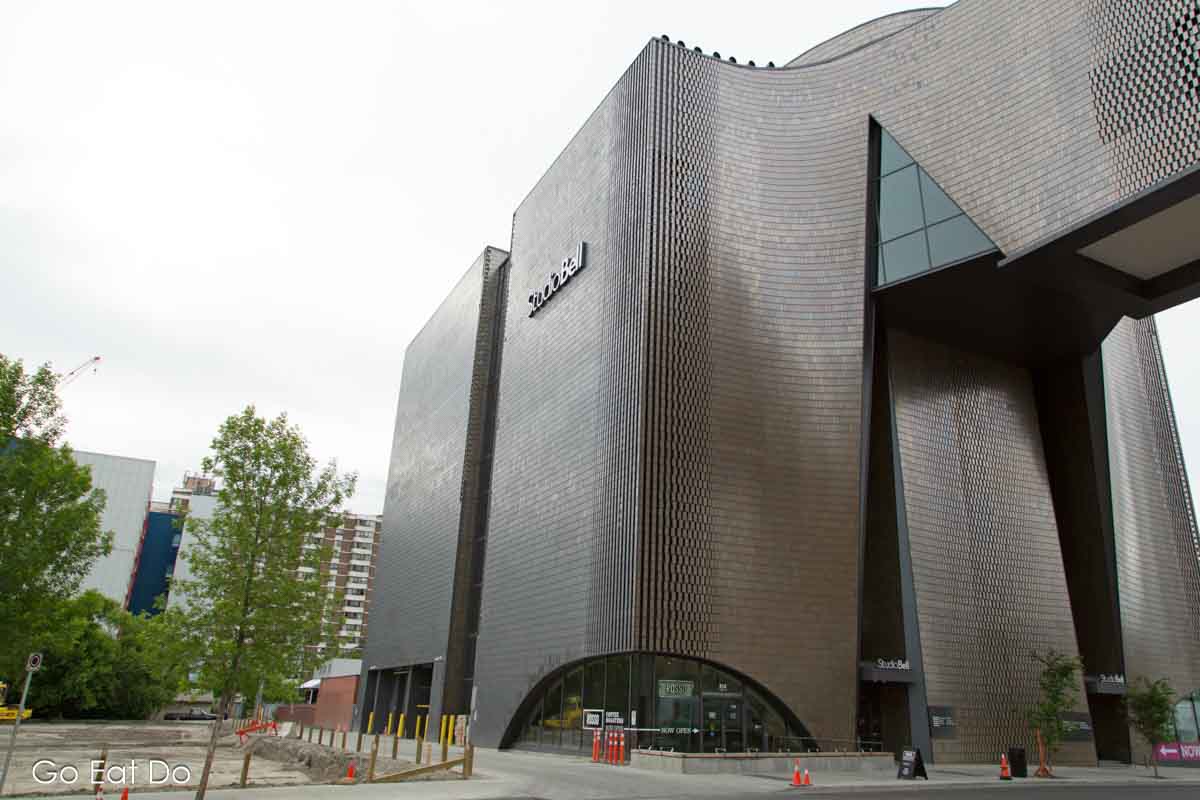
Designed by Allied Works Architecture, a practice led by Brad Cloepfil, the building that houses Canada’s National Music Centre cost CAD$191 million. Remarkably, 1.2 million hours of labour went into the construction.
The façade and lobby are glazed with terracotta tiles serving the dual purpose of amplifying sound and reflecting light. Their earthy tones represent Alberta’s rural landscape.
The King Eddy in Calgary
A sword-shaped neon sign announces the Hotel King Edward on the corner of 9th Avenue SE. The King Eddy, long a popular blues venue, is now part of the NMC. It has been redeveloped into a studio for live shows.
Jason Tawkin, the manager of collections access, is taking a break from a recording session with one of the NMC’s artists in residence. After explaining how musicians from across Canada visit to lay down tracks, he shows me inside the van that’s still known as the Rolling Stones Mobile Recording Studio.
“This deck is where hits by the Rolling Stones, Led Zeppelin and Deep Purple’s Smoke on the Water were first played back,” utters Jason in a reverential tone. Like the recording studios upstairs, the equipment within the studio was state-of-the-art in its day.
A modern recording studio
He shows where he’s spent his day so far, demonstrating how he controls sound levels. One way is by tweaking digital sliders.
Looking for rock stereotypes, I glance around the neat, subtly lit room. There are no empty bottles of Jack Daniel’s. Not even an ashtray, never mind evidence of chain smoking.
That’s just as well. The NMC is a hub for communal activities and plays a role in educational programmes. A group of local school kids jam together in a neighbouring room. Impressively, they aren’t fazed when I pop my head through the door.
I cross the walkway to the other wing of the attraction. Across five themed levels, the NMC’s exhibits are arranged in 22 galleries known as stages. They include the Canadian Music Hall of Fame, the Canadian Country Music Hall of Fame Collection and the Canadian Songwriters Hall of Fame.
Canadian Songwriters Hall of Fame
Inevitably, I recognise the names of Leonard Cohen and Bryan Adams — Canadians who are known around the world. But a handful of band names draw blanks when I go shopping for their tunes in my mental music store.
“What, you don’t know The Tragically Hip? You don’t know The Guess Who?” I’m asked incredulously by a Canadian.
To put my glaring lack of knowledge into context, it would be like a football fan visiting England without the foggiest idea about, say, Chelsea and Manchester City.
Music history at Studio Bell
Thankfully, I flee the embarrassment by moving stages. Browsing quirkier exhibits, representing leaps in musical technology, satisfies the cravings of my inner nerd.
The NMC is home to the world’s only complete Rob Wave electromechanical organ. Dating from 1937, the instrument was at the forefront of electronic sound production — the first to go into commercial production. The depressed economic climate of the 1930s is regarded as a factor in making 16 units.
TONTO — The Original New Timbral Orchestra — is an enormous analogue synthesiser. It was used on albums by Stevie Wonder and The Isley Brothers during the 1970s. Rather than having me press my nose up against his workshop’s glass panelling, John Leimseider, an NMC technician, invites me in for a better view.
The Electronic Sackbut
He explains the challenges of sourcing parts and working on unique, innovative instruments. Cloning the Electronic Sackbut, the world’s first voltage-controlled synthesiser, was one of his tasks. It was developed in 1945 by Hugh Le Caine, a Canadian physicist. To my untrained eye, it looks like a bunch of pegs and dials laid out on top of a wooden palette, not a valuable piece of music history.
The tone of a Kimball Organ, an instrument once played to accompany silent movies, draws me to a crowd enjoying a demonstration. The woman playing explains the organ dates from 1924. Before being donated to the NMC it spent years stored in a basement.
She hammers out The Imperial March (Darth Vader’s Theme), from the film Star Wars. A kid grins upon recognising the melody. That beam of joy is one of the obvious benefits of maintaining musical instruments in good working order.
On returning home, maybe I’ll oil my old trumpet’s valves and play a tune?
Map of Studio Bell, Canada’s National Music Centre
The map below shows the location of Studio Bell, Canada’s National Music Centre:
Best Wider World Tourism Award
There’s a positive post-script to this story. After returning home, I entered Studio Bell, the home of the National Music Centre, into the British Guild of Travel Writers’ annual International Tourism Awards. The awards are open to tourism-related projects opened during the preceding three years. Studio Bell was awarded a Certificate of Merit in the 2017 awards.

Travel to Calgary, Alberta
I flew with Air Transat direct from London Gatwick to Calgary International Airport.
Air Transat’s Option Plus provided priority check-in, with a dedicated counter and a supplementary checked baggage allowance. Additionally, Option Plus brought seat selection, priority boarding and perks for onboard comfort, including a comfort kit with a blanket and sleeping mask, plus headphones for in-flight entertainment.
Canadian Affair (tel. 0203 424 6316) has been arranging holidays in Canada since 1995.
Hotels in Calgary
Use the map below to search for accommodation in Calgary:
Things to do in Calgary
For more information about things to do in Calgary, see the Visit Calgary website.
For ideas about things to do in the surrounding region and further afield, check out the Travel Alberta and Destination Canada websites.
Books about Calgary
Planning to visit Calgary, Alberta? You can discover more about the city and province in these books, available from Amazon.co.uk:
111 Places in Calgary That You Must Not Miss by Jennifer Bain.
Fodor’s Travel’s Canadian Rockies guidebook.
Lonely Planet’s guidebook to Banff, Jasper and Glacier National Parks.
Further information
Thank you for visiting Go Eat Do and reading this post about visiting Studio Bell, Canada’s National Music Centre. If you are planning your first trip to Calgary, you may benefit from reading an introduction to Calgary, Alberta.
Stuart Forster, the author of this post, was presented with the 2017 British Annual Canada Travel Award (BACTA) for Best Online Content.
Photos illustrating this post are by Why Eye Photography.
If you enjoyed this post, please sign up for the free Go Eat Do newsletter. It’s a hassle-free way of getting links to posts once a month.
‘Like’ the Go Eat Do Facebook page to see more photos and content.
This post was initially published on Go Eat Do on 26 October 2027.

Lucy Dodsworth
October 27, 2017 at 11:59What a fascinating place! Great that the space is being used in so many different ways and it’s really part of the community as well as something for visitors. (By the way I had to Google The Tragically Hip after someone mentioned them to me when I was in Canada as I’d never heard of them either!).
Stuart Forster
October 29, 2017 at 12:10Thanks Lucy. For a while I thought it was just me that somehow hadn’t heard The Tragically Hip!
Becky Moore
October 27, 2017 at 20:57Looks like a great place to visit for music lovers, fascinating collection of artefacts they’ve got there!
Stuart Forster
October 29, 2017 at 12:11That’s right. I think that so many of them are still played enhances appreciation of the collection.
Kathryn @TravelWithKat
October 29, 2017 at 11:02What a fascinating place to explore! Brings back so many musical memories. A worthy nomination for the awards.
Stuart Forster
October 29, 2017 at 12:14Thanks, Kat. The enthusiasm and knowledge of the staff make it a joy to visit. I was impressed to see both amateur and professional musicians making use of the spaces within the building.
Heather Cowper
October 31, 2017 at 18:01Sounds like a mecca for music nerds and wannabes – I fear I would know even less of the household names than you, excepting the Rolling Stones of course.
Stuart Forster
November 6, 2017 at 18:26The great thing is it’s possible to listen to a lot of music while there, so it’s an opportunity for those of us who are not so good in pop quizzes to learn.
Eric Fox
February 17, 2018 at 22:35Cool idea! We’ll plan a visit during our fly-drive!
Stuart Forster
February 19, 2018 at 08:47Enjoy your visit!