
Stuart Forster discusses the cultural nuances of drinking coffee at Café A Brasileira in Lisbon, Portugal.
Disclosure: Some of the links below and banners are affiliate links, meaning, at no additional cost to you, I will earn a commission if you click through and make a purchase.
Pausing for a coffee can be a way of viewing the soul of the Portuguese nation.
“It’s a cultural thing, drinking coffee. The Portuguese really enjoy drinking coffee. It’s like having a moment for yourself, when you just stop what you are doing and have a cup of coffee,” comments Rui, a man who works in downtown Lisbon
Coffee and fado in Lisbon
Travellers visiting Lisbon and keen to experience Portuguese culture often head out at night for a Fado show after pounding the city’s cobbled pavements sightseeing in Lisbon. In 2011 Fado, a soulful form of guitar-accompanied song in which stories of love and fate are often told, was inscribed by UNESCO as an Intangible Cultural Heritage of Humanity.
The first mentions of Fado being performed in Lisbon date to the early nineteenth century.
Interested in seeing live fado in Portugal? The Tasco do Jaime, Ageda Machado and Sr Fado de Alfama count are among the best places for Fado music in Lisbon.
Coffee, though, has been appreciated in the Portuguese capital for even longer. Cafés serving good coffee are scattered throughout Lisbon. The clatter of ceramic saucers being placed on marble countertops, the triple tap of used coffee grinds being banged into bins and the hiss and splutter of espresso machines are background noises to daily life.
Technically speaking, Portugal is an Atlantic land. Yet its climate and character are essentially Mediterranean. Romantics might even regard those everyday cafe sounds as the percussion and accompaniment to the real-life melody of chattering conversations.
Café A Brasileira
So where can you get the best coffee in Lisbon? Café A Brasileira is a contender. The long-established café is in the centrally situated Chiado district. A Brasileira was opened in 1905 to sell coffee imported from Brazil. It is reputedly the first place to serve the bica, the rich-tasting, roundly roasted and strong espresso-like coffee that is today regarded as a typical Portuguese cup of coffee.
Many visitors to the city find the facade of the cafe a good spot to pause and take photos. That’s partly because of the building’s eye-catching Art Nouveau curves and a smiling bow-tie-wearing character above the door. That figure is closely associated with the A Brasieira brand.
Tourists tend to sit outside, on the terrace, under the orange umbrellas that more often than not provide shade from the sun rather than shelter from rain. Locals, on the other hand, try to take a table within the cafe’s darkened interior. If alone, they might stand by the counter that runs the whole length of the mirrored bar.
The interior is an atmospheric example of Art Deco, designed by José Pacheco in 1922. The mirrored walls, dark oak panelling and brass fittings have provided the setting for countless coffee-accompanied conversations over recent decades.
From seats on the Café a Brasileira’s terrace, it’s possible to look at two of Lisbon’s best-known statues.
Statues of Ribeiro and Pessoa
One depicts Antonio Ribeiro, a poet who lived from 1520 to 1591. His nickname Chiado, meaning ‘the squeaker’, was eventually adopted for this part of town.
The other figure is Fernando Pessoa. The highly regarded poet and literary critic lived from 1888 to 1935. His statue sits among the patrons on the terrace.
Anyone looking forward to a quiet coffee on a summer’s day should be warned that that’s unlikely if they choose to sit at a table adjacent to Pessoa’s statue. It is one of the most photographed locations in Portugal.
For many years, Fernando Pessoa was a regular visitor to the Café a Brasileira. It was here that he met writers, artists and other intellectuals. In the years that followed the revolution of 1910, when Portugal became a republic, Pessoa and his friends believed that Portugal needed to look forward and change.
Modernism and Fernando Pessoa
They were Modernists. Collectively they became known as the Group of Orpheu and founded a short-lived magazine, Orpheu. Pessoa, often writing in character under other names, became one of Portugal’s most respected literary figures and a keen observer of Lisbon life.
After Pessoa’s death, the café continued to be frequented by intellectuals and artists. That association continues.
Pausing to appreciate the atmosphere of Café a Brasileira — watching people chatting at the bar, observing Lisboetas (as locals call themselves collectively) bustling in and out, sharing a joke with friends or quietly reading a newspaper — is an opportunity to see Lisbon as Pessoa might have done.
Portuguese coffee in Lisbon
It also provides a chance to experience the significance that meeting for a coffee plays in the everyday life of Portugal.
“Drinking coffee in a cafe is all about meeting friends. It’s a social encounter. The flavour is different also but it’s about getting together with people…coffee is a great reason to be with the people you really like,” says Rui before heading back to work.
Map of Café A Brasileira
Café A Brasileira is at Rua Garrett 120 in Lisbon, Portugal:
Hotels in Lisbon, Portugal
Looking for accommodation in Lisbon? You can search for hotels in Portugal’s capital city using the map below:
Practical tips for visiting Lisbon
Buy a Lisboa Card
The cards are designed for use by visitors using public transport to visit cultural attractions. A Lisboa Card includes entry to 52 museums, places of interest and monuments, including the Tower of Belém, Jerónimos Monastery and Lisbon’s castle.
Use public transport
24-hour passes offer unlimited journeys on Lisbon’s network of trams, buses and metros.
Travel from the airport
The Metro’s Red Line connects Lisbon International Airport with the city centre, meaning it’s possible to reach the downtown area in approximately 15 minutes.
Books about Lisbon and Portugal
Planning a trip to Lisbon? You can buy the following books from Amazon.co.uk:
Lonely Planet’s Portugal guidebook.
Lonely Planet’s Pocket Lisbon guidebook.
The World Atlas of Coffee by James Hoffmann.
Useful travel information
Find more things to do and see in and around Lisbon on the Visit Lisbon and Visit Portugal websites.
Further details
Thank you for visiting Go Eat Do and reading this post about drinking coffee in Lisbon at Café A Brasileira. Thinking about a short break in the Portuguese capital? Take a look at this two-day guide to Lisbon. Like transport museums? Plan a trip to the Museu da Carris in Lisbon’s Alcantara district.
Stuart Forster, the award-winning travel writer, is the author of this post. He lived for two years in Lisbon.
If you enjoyed this post, please sign up for the free Go Eat Do newsletter. It’s a hassle-free way of getting links to posts once a month.
‘Like’ the Go Eat Do’s page on Facebook to see more photos and content.
A version of this post was originally published on 11 August 2013.

Glen Goldman
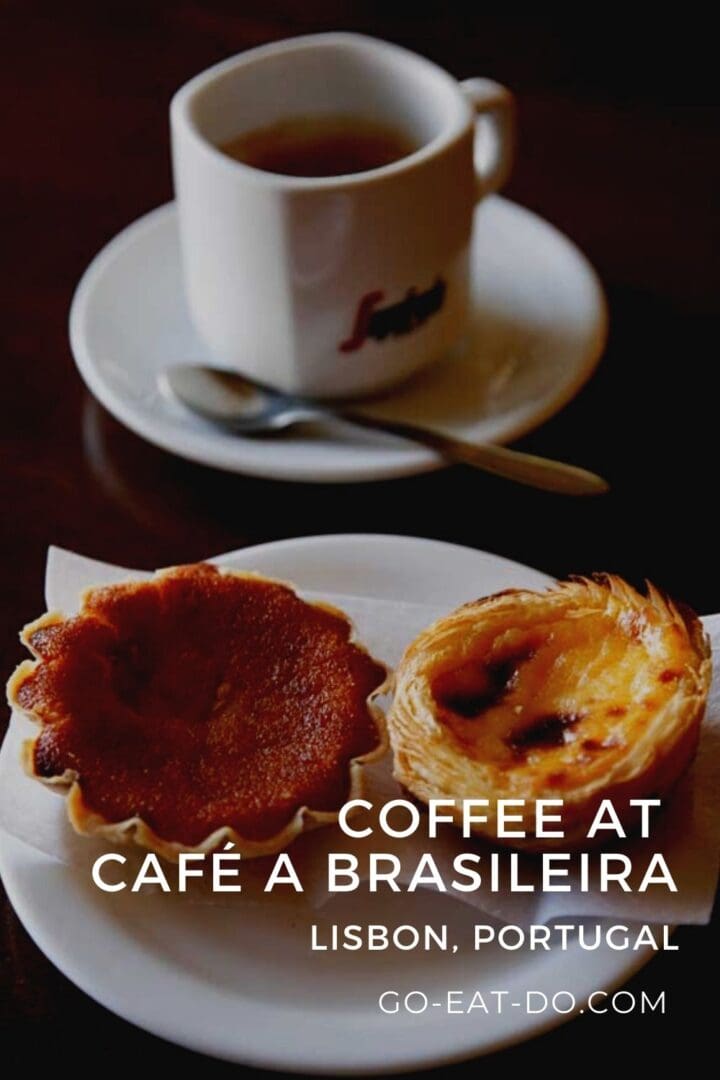
January 26, 2020 at 15:25Great photo of coffee in Portugal. I’d love to read and see more photos like it.
Stuart Forster
January 29, 2020 at 09:36Thanks for your positive feedback. Coffee with cake is one of the joys of visiting cafes in Lisbon!
Jacob Alexander
August 7, 2020 at 19:23Excellent article about Portugal – thanks for posting.
Great Work!
Go Eat Do
December 16, 2020 at 10:03Thanks for stopping by to take a look at Go Eat Do.