Stuart Forster finds that a Swiss Food and Culture Tour in Interlaken, Switzerland, provides insider perspectives of the region’s culinary heritage.
Disclosure: Some of the links below and banners are affiliate links, meaning, at no additional cost to you, I will earn a commission if you click through and make a purchase.
“Alpchäs — Alp cheese — is only called that when it’s made from the milk of cows grazing up on the meadows, high in the Alps,” says Sara, my guide, as I savour the herby flavour of a deep yellow chunk of the creamy Swiss cheese.
We’re at on the first stop of the Swiss Food and Culture Tour and I’ve already demolished a plate of cheeses in Chäs Fritz (Hauptstrasse 90), a store stocking dairy produce and an impressively diverse range of fondue pots. I particularly like the look of one emblazoned with a cute looking cartoon cow.
Each summer, herds of cows are driven up into Alpine pastures where milk is produced in farm cottages aged between 200 and 400 years old. In autumn, during a tradition known as the Alpabzug, the cows are ceremoniously brought down to the valley. Sara explains how it’s possible to see them coming through nearby Lauterbrunnen each September.
Alpine cheese festival
That’s when the farmers of Justistal meet in for the Chästeilet, a festival whose origins can be traced to 1739. It’s possible to purchase cheese there and see the summer’s output being shared between producers.
The cheeses I’ve just eaten are made using traditional methods, in vats over wood-fuelled fires then pressed into wheels and massaged with salt.
Starting with the mildest cheese first, Weisse Spinne, we moved through a plate with Reblochon, Lenker Blau, plus a more mature cheese that lends itself well to being melted on a raclette and served with rösti, the traditional Swiss potato preparation.
The Funky Chocolate Club
As we walk to our next stop, the Funky Chocolate Club (35 Jungfraustrasse), Sara explains how traditional Swiss meals, including raclette and fondue, tend to be social occasions.
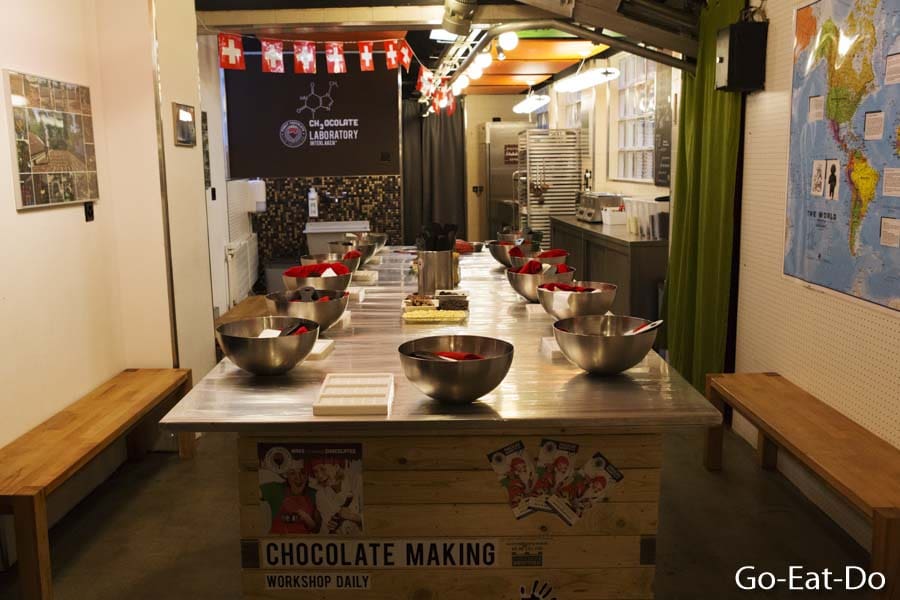
In addition to selling chocolate, Michaela and Tatiana, the store owners, run chocolate making workshops.
Tatiana explains the process of making chocolate to me. Milk chocolate marries the produce of Swiss cows and imported cocoa beans. Tempering the chocolate gives it a bright sheen.
I learn that appreciating good chocolate should involve all of our senses. Even the sound of the snap is important. She lets me sniff organic cocoa beans, whose aroma is far more powerful than those which have been cultivated.
Rather than biting into it straight away, Tatiana says that people should let chocolate sit on their tongue to melt —that maximises the enjoyment and means less is consumed.
Interlaken lies in the canton of Bern, where Toblerone was invented over a century ago.
Traditional Swiss woodcarving
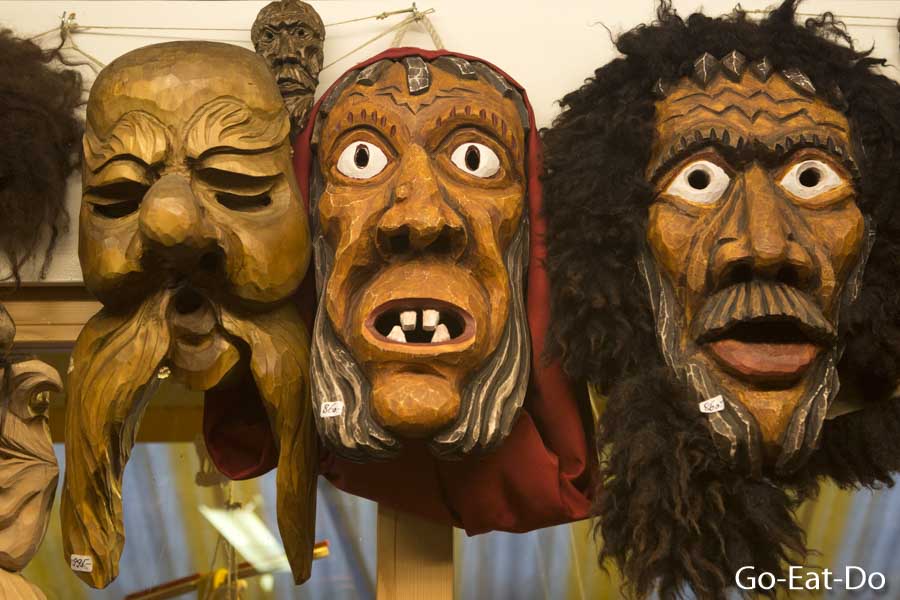
After buying a bag of organic dark chocolate buttons, we make our way to Woodpecker (30 Marktgasse), where Gabriela stands next to some of her creations and explains her passion for woodcarving.
Gabriela studied at the woodcarving school in nearby Brienz, which has a museum dedicated to the subject, before taking over the workshop that her father founded in 1993.
After talking about nativity figures with exquisite details, she explains that the gruesome masks that hang from the walls have a long history. They were originally made to get rid of evil spirits.
Meeting Cinderella in Matten
The final halt on our tour involves travelling a couple of stops by bus to the nearby village of Matten.
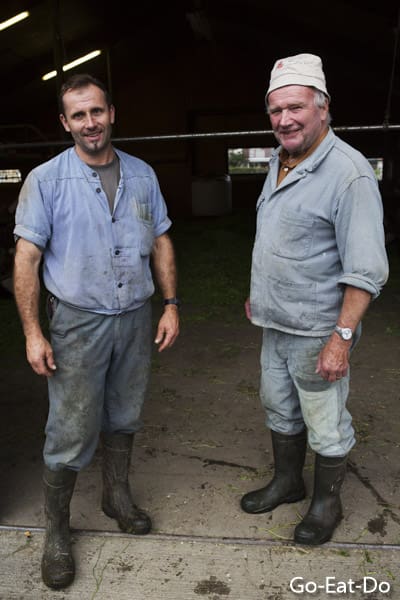
Sara leads me into a barn behind a large wooden chalet, where we’re greeted by Peter, who along with his father, runs one of Matten’s three farms. Though the chalet’s facade looks old, the farm makes use of modern technology.
Their herd of Simmental cows, including one called Cinderella, are chewing hay.
The unpasteurised milk produced by this herd is creamy and has a lot more flavour than that standard supermarket-bought milk that we taste too.
Within the farm’s dimly lit cellar, I see how locally grown apples and potatoes are stored.
We walk to a nearby bus stop and head back to Interlaken, where I thank Sara for the insights into the region’s traditions.
Booking a SWISS Food and Culture Tour
You can book a Swiss Food and Culture Tour online.
Map of Interlaken
The map below shows Interlaken’s position between Lake Thun and Lake Brienz. Zoom into the map for more details:
Travel to Interlaken
KLM operates flights to Zurich Airport via its Amsterdam Schiphol hub.
SWISS flies between London Heathrow and Zurich. easyJet operates flights to Zurich from London Gatwick.
Hotels in Interlaken
Search for accommodation in Interlaken or the surrounding region using the map below:
Things to do in Interlaken
Find information about the town and the surrounding area on the Interlaken website.
The Jungfrau and Switzerland websites have information about things to do in the surrounding region.
Books about Switzerland
Planning a trip to Interlaken or elsewhere in Switzerland? You can buy the following books from Amazon.co.uk:
DK Switzerland guidebook.
Switzerland: The Essential Guide to Customs & Culture by Culture Smart!
The Rough Guide to Switzerland.
Further information
Thank you for visiting Go Eat Do and reading this post about the Swiss Food and Culture Tour in Interlaken, Switzerland. If you are planning on visiting the region, you may also enjoy this post with local tips on things to do in Interlaken.
Stuart Forster, the author of this post, is an award-winning travel writer. He speaks fliuent German.
Photos illustrating this post are by Why Eye Photography.
If you enjoyed this post, please sign up for the free Go Eat Do newsletter. It’s a hassle-free way to get links to posts once a month.
‘Like’ the Go Eat Do Facebook page to see more photos and content.
