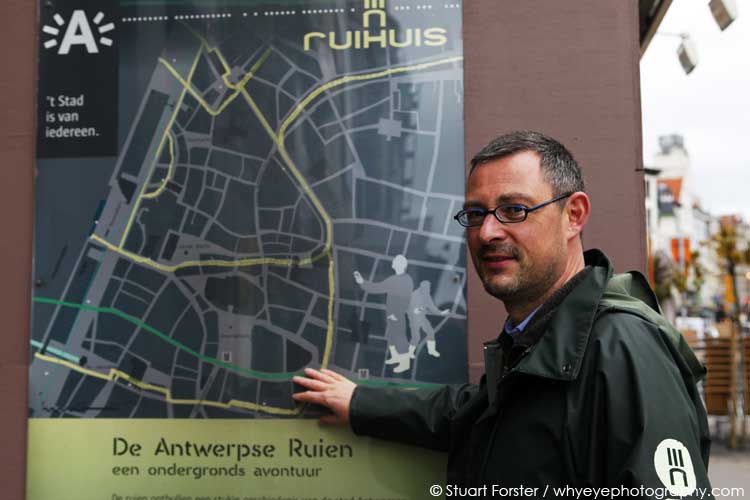
Stuart Forster visits the Antwerpen Ruien, underground canals which are the largest historic monument in Antwerp, Belgium.
Disclosure: Some of the links below and banners are affiliate links, meaning, at no additional cost to you, I will earn a commission if you click through and make a purchase.
I’ve pulled on a disposable overall. I’m holding a torch and have a camera slung around my neck. If it wasn’t for my floppy black wellies, you might take me for some crime scene investigator. The kit is compulsory for tours of Antwerp’s underground canals, the Ruien as they are known here.
Rick Philips, my guide, has met me at the entrance to the Ruihaus at Suikerrui 21. It’s the starting point for tours of Antwerp’s Ruien.
“Sometimes it’s a little bit dirty. That’s why you have the protective suit. The entry price includes the suit. If it’s still okay, afterwards you can take it home with you. A lot of people do; you can use it for painting and things,” he says.
Underground in Antwerp
Like most visitors to Antwerp, I had no idea that the city was once characterised by an eight-kilometre (five-mile) network of waterways: much as Bruges or Amsterdam are today. The Antwerp Ruien is one of Flanders’ largest historic monuments.
If you’re at ground level in Belgium’s second-largest city, the width of a street is one of the best indicators if water flows below. Many of the broader streets have canals underneath. If a street name features the word ‘brugge,’ the Flemish for bridge, that’s also a good indicator a waterway was built over.
Ruien tours were conducted by boat in 1964 and 1965, when the subterranean canals carried wastewater. Consequently, they smelt and the popularity of tours soon waned. Following improvements to the water quality, the Ruien were re-opened to the public 40 years later.
The smell is now a tad stagnant and dank but by no means repugnant; sewerage runs along enclosed pipes. The water we’ll see comes from the likes of dishwashers, showers and, on rainy days, gutters.
Giving me the wellies
Water levels rise by up to 30 centimetres during rainstorms. Children’s wellies aren’t that high, so these tours are only for adults.
Rick is passionate about guiding and history. We’ve been chatting about Antwerp’s significance in medieval Europe, when, after Paris, it was the second-largest city north of the Alps. He explains our tour will last two hours and there’s a slim possibility we may need to leave the Ruien at short notice should the local water authority need to shift stock along the canals. He carries a walkie-talkie and mobile phone to stay informed.
We enter Antwerp’s Ruien via a lockable gate and Rick explains that the canals are constructed of brick and stone. Most date from the 16th century. From the late 1500s to 1885 they were enclosed. Non-corroding, ceramic street signs mark their names.
Underground boat trip
For the first 300 metres, where the water is at its deepest, we take a boat. It has 15 seats; the upper limit on participation in these tours. Throughout the remainder of the tour we’ll walk. Rick warns me to follow his line as each tunnel has a 15- to 50-centimetre-deep drainage channel running along it. I nod. I wouldn’t want to stumble.
I ask if we’ll see rats. Rick looks at me. “Sometimes we see one, sometimes a hundred. We are going into their habitat and have to accept they will be there,” he answers calmly and adds we’ll also see rare black and brown spiders.
Hidden wildlife and history
We walk by what appears to be a huge chimney bringing fresh air underground and then pass a couple of locks. Rick shines his torch up at the ceiling. “We have something like 200 different types of vault,” he says, “some are nine metres wide and six high, and there are spots no wider than three metres by two.” Locals living by canals led the initiative to enclose them. The materials – including brick, sandstone and bluestone – reflected people’s wealth.
Antwerp’s first canal was the moat that once flowed around the city walls. “Paris, London, Vienna and Prague have huge underground sewerage systems that look like this in red brick but they are nineteenth-century. In Antwerp, there are medieval vaults that had another function and then became a sewerage system; that is unique,” says Rick as we plodge ankle-deep in water then pause as a tram thunders above us.
St Charles Borromeo Church
“The Jesuits had an exit-entrance here,” explains Rick, pointing to a well-crafted section of underground sandstone. We’re standing below the Carolus Borromeuskerk, the church once renowned for ceiling panels painted by Rubens. “We don’t know why. Some say it was to flee if there were problems with the Protestant minority. But the Jesuits came with the Spanish and the city was made Catholic in just four years. Some people say it was because the monks and priests went on small ships to the north of the city, the Schipperke, which has been the red light district for centuries.”
“What we do know is that in World War One, when Antwerp was occupied by Germans, English goods were smuggled under the city and given to the population via this church. It was changed into this brick wall in 1934,” he adds.
Wartime escape route?
“People also say the Ruien were used to help our Jewish population escape during World War Two but there’s no real proof.”
During their second occupation, the Germans closed and guarded possible entry points to the ruien.
We come to an underground exhibition on the canals’ enclosure and waterborne infections such as measles and typhus. I read how 2,961 people died during the Antwerp 1866 cholera epidemic, resulting in calls for all of the city’s open waterways to be covered.
Antwerpen Ruien
As the tour draws to a close, at Burggracht, Rick leads us to an underground chapel housing the statue of a saint. Workers once prayed here for protection against problems such as methane explosions.
I decide to reflect on the fascinating tour with a beer in Paters Vaetje (Blauwmoezelstraat 1), a bar that Rick recommended as we walked below.
Ruien Antwerp tickets
Experience an underground tour of Antwerp. Book tickets to visit the Antwerp Ruien online.
Map of the Antwerp Ruien entrance
The entrance to the Antwerp Ruien is at the Ruihuis at Suikerrui 21, a short walk from the Grote Markt:
Hotels in Antwerp
Find accommodation in Antwerp using the map below:
Books about Antwerp
Keen to know more about Antwerp? You can buy the following from Amazon:
Michael Pye’s Antwerp: The Glory Years.
The 500 Hidden Secrets of Antwerp by
Useful travel information
For more on touring Antwerp’s underground canals, see the Visit Antwerp website.
Visit Flanders has more on attractions in Antwerp and the surrounding region of Belgium.
Further details
Thank you for visiting Go Eat Do and reading this post about touring the Antwerpen Ruien: underground canals in Antwerp. If you are heading to Antwerp, you may be interested in sampling a revived beer that was long enjoyed in Antwerp.
Stuart Forster, the author of this post, is an award-winning travel writer. He has studied in Leiden, the Netherlands, and taught at Breda University of Applied Sciences.
Photos illustrating this post are by Why Eye Photography.
Enjoy this post about the underground Ruien in Antwerp, Belgium? Please sign up for the free Go Eat Do newsletter. It’s a hassle-free way of getting links to posts once a month.
‘Like’ Go Eat Do’s Facebook page to see more photos and content.